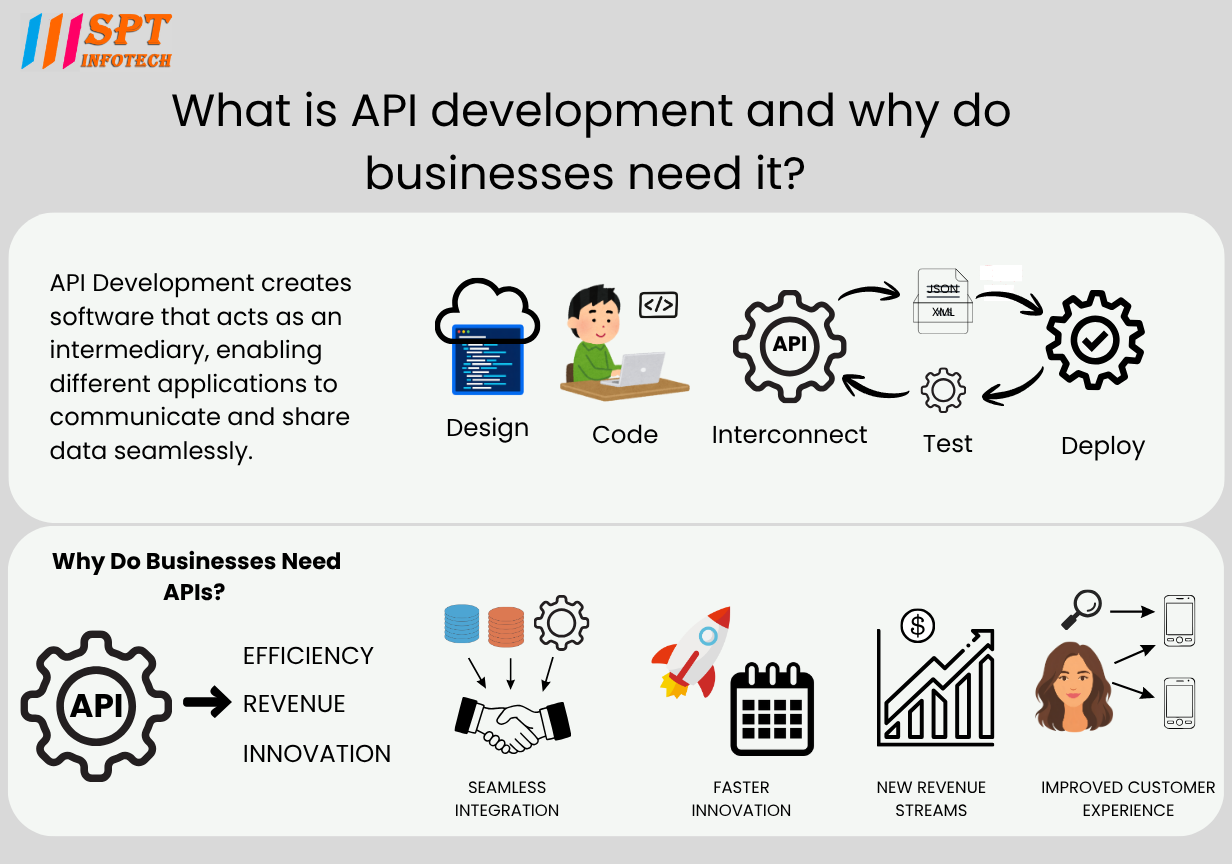
What is API development and why do businesses need it?
API development is the process of creating application programming interfaces. An API is a set of rules and protocols that allows two software applications to communicate with each other. The term API is often used to describe the interface that enables one application to access the functionality of another.
Modern businesses don’t tend to rely on a single piece of software. An e-commerce site will typically have a separate system for payments, a separate one for inventory, a separate one for shipping, a separate one for customers and a separate one for orders. A services business will have a separate system for bookings, a separate one for customer management and a separate one for reporting.
But how do the various systems share information and work in conjunction with each other?
This is where APIs come in.
API development enables different software applications to talk to each other, pass information to each other and carry out specific tasks without the need for everything to be built into one monolithic system.
For businesses looking to invest in digital technology, understanding APIs can be a way of identifying opportunities to improve their operations, automate some of their processes and create better customer experiences.
What is an API?
API (Application Programming Interface) is a set of rules and mechanisms that allows different applications or components to talk to each other.
Think of an API as a bridge between two systems.
For instance, when a customer buys something from an online store, the website will talk to a payment gateway via an API. The payment system will process the transaction and send a response back to the website.
The customer doesn’t need to understand what’s going on behind the scenes at all. They just need to see whether the payment has gone through.
APIs enable these interactions in a structured and controlled manner.
What is API development?
API development is the process of designing, building, testing, documenting and maintaining the interfaces that allow software systems to communicate with each other (i.e., exchange data and functionality).
Developers build APIs in response to the requirements of the apps that need to talk to them.
This could involve defining endpoints, picking a data format, deciding on authentication, managing the requests and managing access to the data.
Common API technologies are REST, GraphQL and SOAP. They all have different characteristics and one or another may be appropriate for a particular project.
For example, REST APIs will typically use the various HTTP methods (GET, POST, PUT, DELETE etc.) to retrieve, create, update and delete resources.
Why do businesses need API development?
A business will need to develop an API for a number of reasons. The most obvious is that it will need to connect to a third-party service (e.g., to pull in data from a CRM or ERP system). A business will also need to expose its own data and functionality to external parties (e.g., to allow a partner to access its product catalogue or to enable a developer to build an application on top of its platform).
APIs are useful in that they allow you to connect your existing technology rather than having to manage each bit of it in isolation.
Here are some key benefits.
1. Connect Different Business Applications
Businesses will typically use a number of different tools to manage their day-to-day operations.
For instance, an online store might be using one app for their customer information, one for their inventory and a separate one for their payments.
APIs enable the systems to pass on the relevant information. That in turn, reduces the need for staff to be manually transferring data from one system to another.
2. Automate Repetitive Tasks
Manual work can eat up a lot of time, particularly when staff are continually entering the same data into various systems.
With API integration, you can automate certain activities.
For instance, when a customer places an order, an API can be used to send the order details to an inventory system, update the appropriate records and then pass on the order to a shipping platform.
This can reduce the amount of repetitive work and eliminate the errors that can occur through manual data entry.
3. Improve Customer Experience
Customers expect their digital services to work seamlessly.
An app that enables users to book appointments, make payments, get notifications and check the status of their bookings.
APIs can be used to connect the various services that are required to support these features.
When the systems communicate well, the customer can complete the task more easily without having to jump around from one system to another.
4. Support Business Growth
As businesses grow, their technology needs tend to get more complex.
They might bring in new apps, new payment options, new customer service tools, new reporting tools, etc.
A well-designed API architecture can make it a lot easier to connect to new services without having to rebuild the whole application.
This gives businesses far greater flexibility as they grow.
5. Enable Third-Party Integrations
Lots of businesses rely on third-party services to deliver their products and services.
Common examples include:
- Payment gateways for processing online transactions.
- Shipping APIs for delivery updates and tracking.
- Maps APIs for location-based services.
- CRM APIs for managing customer information.
- Email and SMS APIs for automated communication.
These integrations enable the business to use the specialist services whilst still keeping their own apps connected.
Common Types of APIs
Different APIs do different things. Some common categories include:
REST APIs: These are the big boys when it comes to communicating between a web app and a server. They’re typically the ones that pass data around in JSON.
GraphQL APIs: The client can request exactly the fields it wants. That’s useful if you’ve got an app that needs a bit of control over what data it’s retrieving.
SOAP APIs: use a structured messaging protocol and are found in some enterprise and legacy systems.
Private APIs: For internal use within the organisation.
Public APIs: Available to external developers and/or businesses, usually with some form of access restrictions.
The right API approach will depend on the architecture of the application, the security requirements, the integration requirements and the anticipated usage.
Important Factors to Consider During API Development
Developing an API is not simply about getting two systems to talk to each other.
Security should be paramount. Authentication, authorisation, encrypted communication and appropriate access controls are all key to protecting sensitive information.
Performance also comes into it. Badly designed APIs can cause all sorts of delays and have a negative impact on the apps that use them.
Developers should also be looking at documentation, error handling, versioning and monitoring. All of those things make an API far easier to maintain and improve upon over time.
Testing is just as important, as an integration issue can impact a number of interconnected systems.
Final Thoughts
API development is a key enabler in modern software. It allows applications to talk to each other, it enables the automation of business processes, it provides the means for third-party integrations and it makes the platform far more flexible.
Whether you’re building an e-commerce site, a mobile app or a bespoke business management system, APIs can be used to get different bits of the system working together effectively.
At SPT Infotech, businesses can explore web development, mobile app development, and custom software solutions that support their digital requirements. With the right API development and integration strategy, businesses can connect their systems, simplify operations, and create more connected digital experiences.