SaaS vs Custom Software: Which is better for your business?
Every business needs technology to run its operations, to communicate with its customers and to be more productive. Whether it’s managing its people, its sales, its inventory or its customer data, software is a vital part of the business.
However, when you’re looking at a software solution, the question that comes up for most businesses is should they go for a off the shelf SaaS solution or should they go in and do their own software development?
Both options can help a business to work more efficiently, just different things. Which is the right one for you will depend on your business processes, your budget, your need for flexibility and your long-term plans.
What is SaaS software?
SaaS is Software as a Service. It’s software that’s hosted by the service provider and accessed over the internet (typically via a web browser or app).
Rather than buy and install software on individual PCS, businesses will generally just pay a monthly or annual subscription to use it.
Examples include project management platforms, accounting software, CRM’s and cloud comms apps.
One of the big benefits of SaaS is convenience. You can start using the software without having to manage the servers underneath it, the infrastructure or most of the technical maintenance.
Benefits of SaaS Software
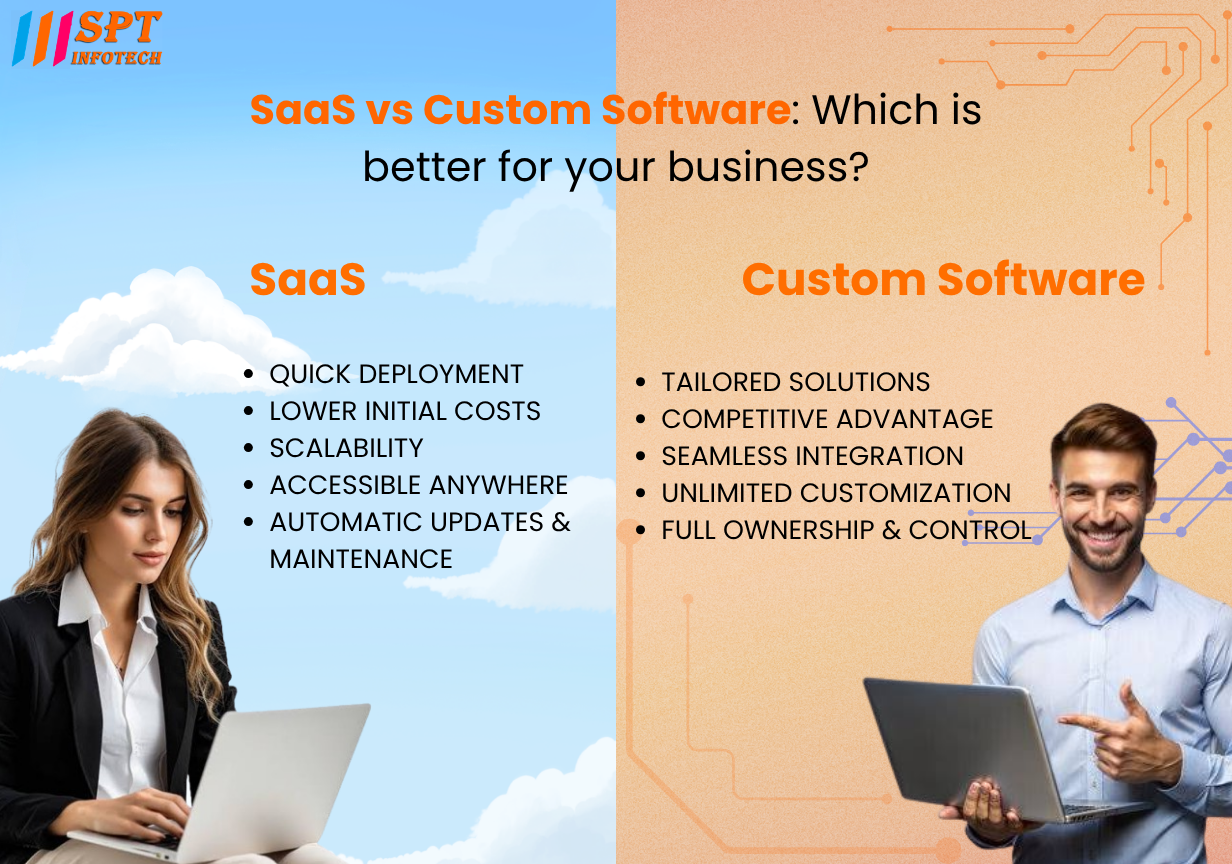
- Lower Initial Investment: The vast majority of SaaS platforms are subscription-based. That enables the business to get access to the software without having to make a big up-front investment in development.
- Quick Implementation: Ready-made software is generally easier to set up. You can create an account, configure the settings and get going with the available features fairly quickly.
- Regular Updates: The provider will generally be responsible for the software updates, bug fixes and infrastructure maintenance. That in turn, reduces the technical burden on the business.
- Easy Accessibility: Employees can access the cloud software from various locations as long as they have an internet connection and the appropriate permissions.
However, SaaS solutions may have their limitations when you need very specific features, very specific workflows or a deep level of integration with your existing systems.
What is custom software?
Custom software is built for the business specifically, to meet its own individual requirements, processes and objectives.
Custom software is built around the way a particular organisation works rather than the other way around.
For instance, a manufacturing company might require a system that links inventory, the production schedule, the supplier data and order management. If the off-the-shelf software isn’t up to the job, then custom development may be the way to go.
Custom software can be developed as a web app, a desktop app, a mobile app or a combination of the above.
Benefits of Custom Software Development
- Built Around Your Requirements: Custom software is built to meet your actual business needs. You can go in and prioritise the features and workflows that are important to you rather than having to work around a standard product.
- Greater Flexibility: As your business grows, you can add features, tweak the existing functionality and add new integrations as your requirements evolve.
- Better Integration Opportunities: Custom solutions can be developed to integrate with existing business systems, databases, APIs and third-party platforms.
- Control Over Features and Development: You have far more influence over the software’s functionality, design and future development roadmap (subject to your development agreement and ownership arrangements).
- Long-Term Business Alignment: A well-thought-through custom solution can grow with your organisation and thus be much easier to support as regards the more specialised processes and changing operational needs.
The principal issues are higher up-front development costs, longer implementation times and the need to plan for ongoing maintenance.
SaaS vs Custom Software: Key Differences
Comparison | SaaS Software | Custom Software |
Development | Ready-made product | Built for specific requirements |
Initial cost | Usually lower | Usually higher |
Implementation | Generally faster | Depends on complexity |
Customisation | Limited by provider | Greater flexibility |
Maintenance | Mostly provider-managed | Requires an agreed maintenance plan |
Scalability | Based on available plans | Can be designed around business growth |
Ownership | Subscription-based access | Depends on the development agreement |
Integration | Supported integrations | Can be developed for specific systems |
Which option is better for your business?
There’s no one-size-fits-all answer for every organisation.
SaaS software would be the way to go if you’re a startup or small business looking for an affordable solution with the standard features. It’s also the way to go if you need to get a system up and running quickly without having to manage the underlying technical infrastructure.
Custom software may be the right option if you have very specific workflows, complex operational requirements or indeed just need some integrations that the off-the-shelf software simply can’t provide.
A small business dealing with just basic customer records might well be perfectly happy with a ready-made CRM. On the other hand, an organisation that’s got multiple departments, a number of custom approval processes and a requirement for very specific reporting is likely to find that a custom-built solution is the way to go.
Consider the Total Cost Before Deciding
Don’t compare them on the basis of their initial price alone.
With SaaS, consider the subscription charges, additional user licences, storage limits, premium features and potential for price increases.
With custom software, you’d need to consider development, hosting, security, maintenance, updates and future enhancements.
A cheaper solution to start with may end up being very expensive over a number of years, whereas a bespoke solution may require a larger initial outlay but will be more closely aligned to your actual business needs.
The key thing is to look at the total cost of ownership against the value that the software delivers.
Final Thoughts
SaaS and custom software both have their merits. SaaS is obviously very convenient; it’s easy to implement and you have a predictable subscription model. Custom software on the other hand, has the benefit of being able to be tailored to your particular business processes and is far more flexible.
Before you make a decision, make sure you understand your current requirements, your expected growth, your budget and your integration requirements.
At SPT Infotech, you can look at software development solutions that are built around your business needs. You could be looking at a bespoke business application, you could be looking at a fully integrated digital platform or you could simply be looking for advice on how to go about the development of your software. The point is that the software should be developed to solve your actual business problem