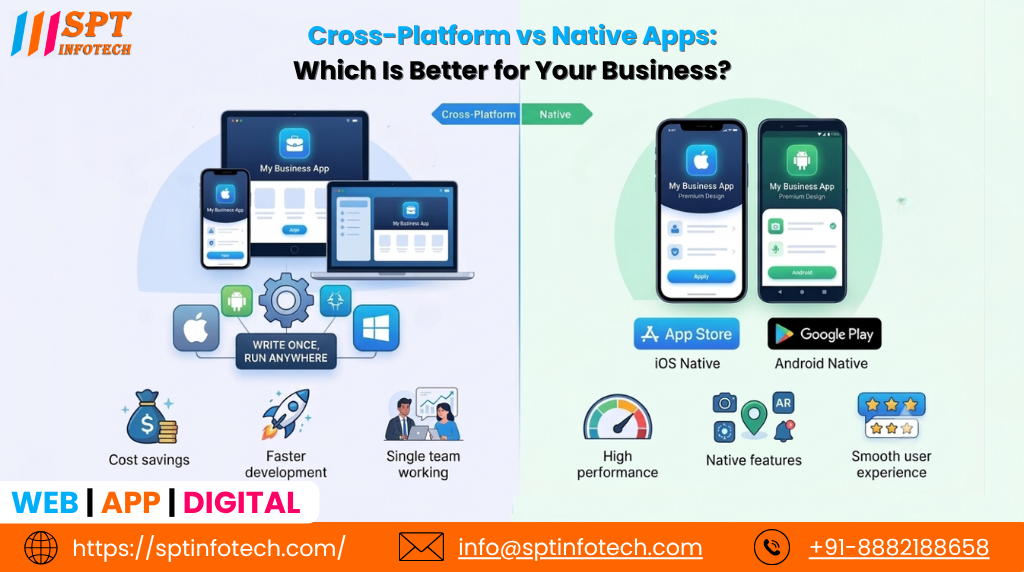
Cross-Platform vs Native Apps: Which Is Better for Your Business?
Mobile applications have become a part of modern business. Whether you run a shop give professional services handle bookings or sell a digital product a mobile app can help customers talk to your business.
Before development begins you must decide: Should you build a native app or choose cross‑platform app development?
Both approaches have strengths and limits. The best choice depends on your budget, target audience, app features, performance needs and long‑term business plans. Let us compare both options so you can decide wisely.
What Is a Native App?
A native app is made for one operating system. For example an Android app is built for Android devices while an iOS app is made for Apple’s ecosystem.
Native development usually uses programming languages that belong to a platform and tools that belong to that platform. Android apps usually use Kotlin while iOS apps usually use Swift.
Because the app is made for its target platform developers can use the operating system’s features and power more fully.
Benefits of Native App Development
One of the benefits of native development is performance. Because the app is tuned for one platform it can give a quick experience.
Native apps also give access to device features like cameras, GPS, biometrics, notifications, Bluetooth and other hardware powers.
Another benefit is design that matches the platform. Developers can use the interface and interaction patterns that users already know on their device.
Native development is especially good for apps that need performance, tough animations, fine graphics or deep device integration.
However, there is a trade‑off. If you want apps for both Android and iOS you normally need work for each platform. That can raise development time resources and maintenance needs.
What Is Cross‑Platform App Development?
Cross‑platform development lets businesses build apps that can run on operating systems using one shared codebase.
Of starting from zero for each system developers can use cross‑platform tools to build Android and iOS apps faster.
This approach can attract startups and businesses that want to launch an app on platforms while keeping development resources small.
Benefits of Cross‑Platform Apps
The benefit is development efficiency. A shared codebase can cut the amount of repeated work needed for each platform.
This can also ease maintenance. When developers need to update parts they can change one codebase instead of separate ones.
Cross‑platform development can also help businesses reach Android and iOS users faster. This is useful when launching a product where quick release is important.
Another benefit is cost efficiency. While the real cost depends on the app’s complexity and team sharing code can lower effort compared with making two apps.
Cross‑Platform vs Native: Key Differences
The choice becomes easier when you compare the factors.
Performance: Native apps usually win when top platform‑specific performance is needed. Cross‑platform apps can still give performance for many business apps.
Development time: Cross‑platform development can be quicker because developers can reuse a lot of code.
Cost: Cross‑platform development can lower costs when launching on platforms though the final cost still depends on features and complexity.
Device features: Native apps usually give the direct access to platform‑specific features. Cross‑platform tools can also support device powers but some special needs may need extra platform work.
Maintenance: A shared codebase can simplify care especially when the same functions are needed on all platforms.
Which One Should Your Business Choose?
There is no universal answer.
A native app may be the choice if your app needs tough graphics, top speed, advanced hardware use or lots of platform‑specific features.
A cross‑platform app may be the choice if you want to reach Android and iOS users fast have a small budget or need to launch quickly.
For example, a business app for bookings, e‑commerce customer management, learning, food delivery or service requests can work well with a cross‑platform approach.
On the hand apps that involve serious gaming, special hardware or tough real‑time graphics may gain more from native development.
Think About the Long‑Term Plan
The decision should not be based only on the initial development cost.
Think about how the app may grow in the years. Will you add features? Will you add payment gateways, APIs, analytics, location services or other platforms? Will you need updates?
Your development way should support those needs.
It is also key to think about your audience. If most customers use Android devices starting with Android may fit. If your audience is mostly in Apple’s world iOS could be the priority. If you need both groups cross‑platform development can give a start.
Final Thoughts
Both native and cross‑platform app development can make mobile apps. The better choice depends on what your business needs.
Native development gives performance, platform‑specific tuning and great access, to device powers. Cross‑platform development can give work shared code and an easy way to reach users on many platforms.
Before deciding think about your audience, features, budget, timeline, performance needs and future plans.
At SPT Infotech businesses can work with a team to pick an approach that fits their goals. A good tech plan can turn your app idea into a digital product that gives real value to your customers.